Modular Battery Lab Automation
Battery laboratories rarely follow a single fixed process. A lab may be screening one material today, qualifying a new electrolyte tomorrow, and moving into new chemistries and cell formats as the programme develops.
Cellerate develops modular automation systems around this reality.
Labs should not have to choose between cheap fixed-function tools and expensive bespoke automation. Cellerate builds compact, configurable platforms that can grow with the lab.
The CASS is the clearest example: a modular system that can support manual assembly, automated assembly, and unattended batch production of coin cells, Protocells, and pouch cells, to suit evolving research workflows. This gives teams a practical route into automation without locking them into a single task, format, or process.
Real Labs Need Flexible Automation
Battery labs are often underserved by both ends of the automation market.
Low-cost benchtop tools are accessible, but leave critical process steps dependent on manual skill. Large bespoke systems can be powerful, but are expensive, slow to specify, and often fixed around a narrow workflow.
R&D is different from stable production. Researchers often need to compare new materials, adjust electrolyte volumes, test different separators, change cell formats, or adapt a procedure as understanding improves. In this environment, rigid automation can become a constraint rather than an advantage.
Cellerate occupies the space between these extremes: high-quality, modular automation that is compact enough for real labs and flexible enough for changing research.
A Staged Approach to Battery Lab Automation
Cellerate systems are designed so labs can begin with the capability they need today, then expand as requirements develop.
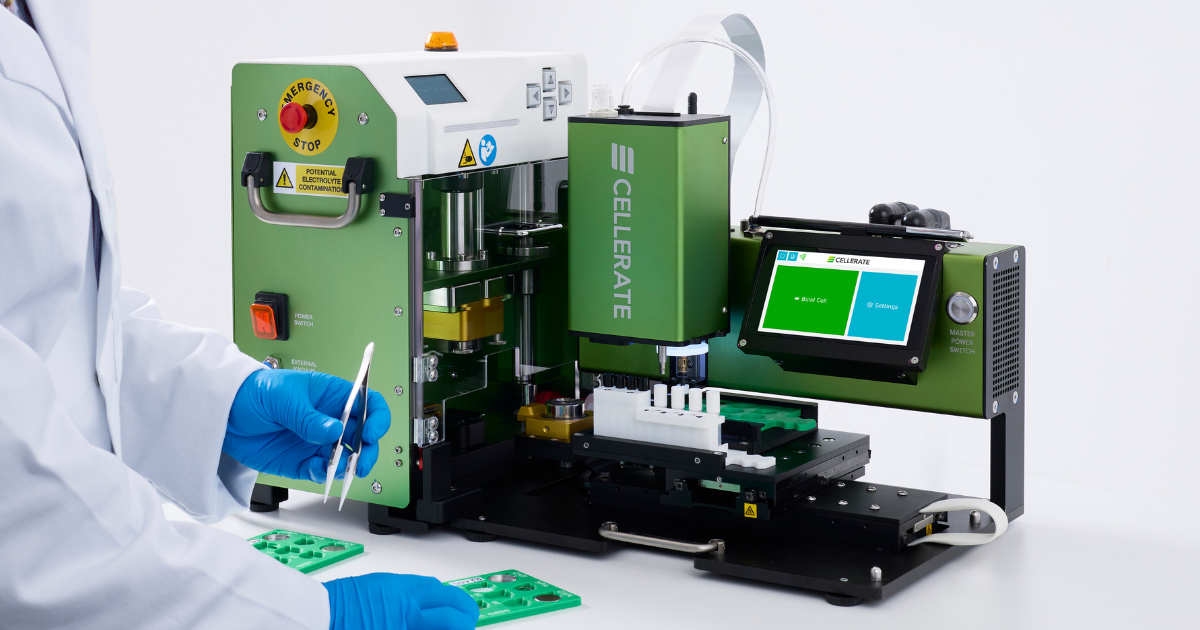
The CASS shows this approach in practice. A team can begin with the Sealer module for reliable coin cell crimping and pouch sealing, then add the Assembler module for automated stacking, electrolyte dosing, machine vision, and build traceability. The Autoloader module expands the workflow further, enabling unattended production of larger batches.
Additional upgrades and accessories allow the same platform to support Protocell and pouch cell assembly, multiple electrolyte workflows, and research-specific procedures.
This staged approach helps labs adopt automation at the right pace, while preserving a clear path to higher throughput, more advanced cell formats, and more controlled experimental workflows.
Automation for Every Stage of Battery Research
Different research questions need different tools.
A team screening new electrode materials may need high consistency across familiar coin cell formats. A group studying pressure-sensitive chemistries may need Protocells with controlled stack pressure and reference electrode access. A development team moving towards larger formats may need pouch cells or more representative assembly workflows.
Cellerate’s modular philosophy is designed to support this progression.
By combining configurable hardware, interchangeable tooling, adaptable software routines, and application-specific accessories, Cellerate systems allow labs to evolve their workflow without rebuilding the lab around a new machine each time.
Designed for Research, Not Just Repetition
In production, automation is often about doing the same thing faster. In research, automation also needs to support controlled variation.
Cellerate systems are designed to standardise the parts of a workflow that should stay consistent, while allowing researchers to deliberately vary the parameters they want to study.
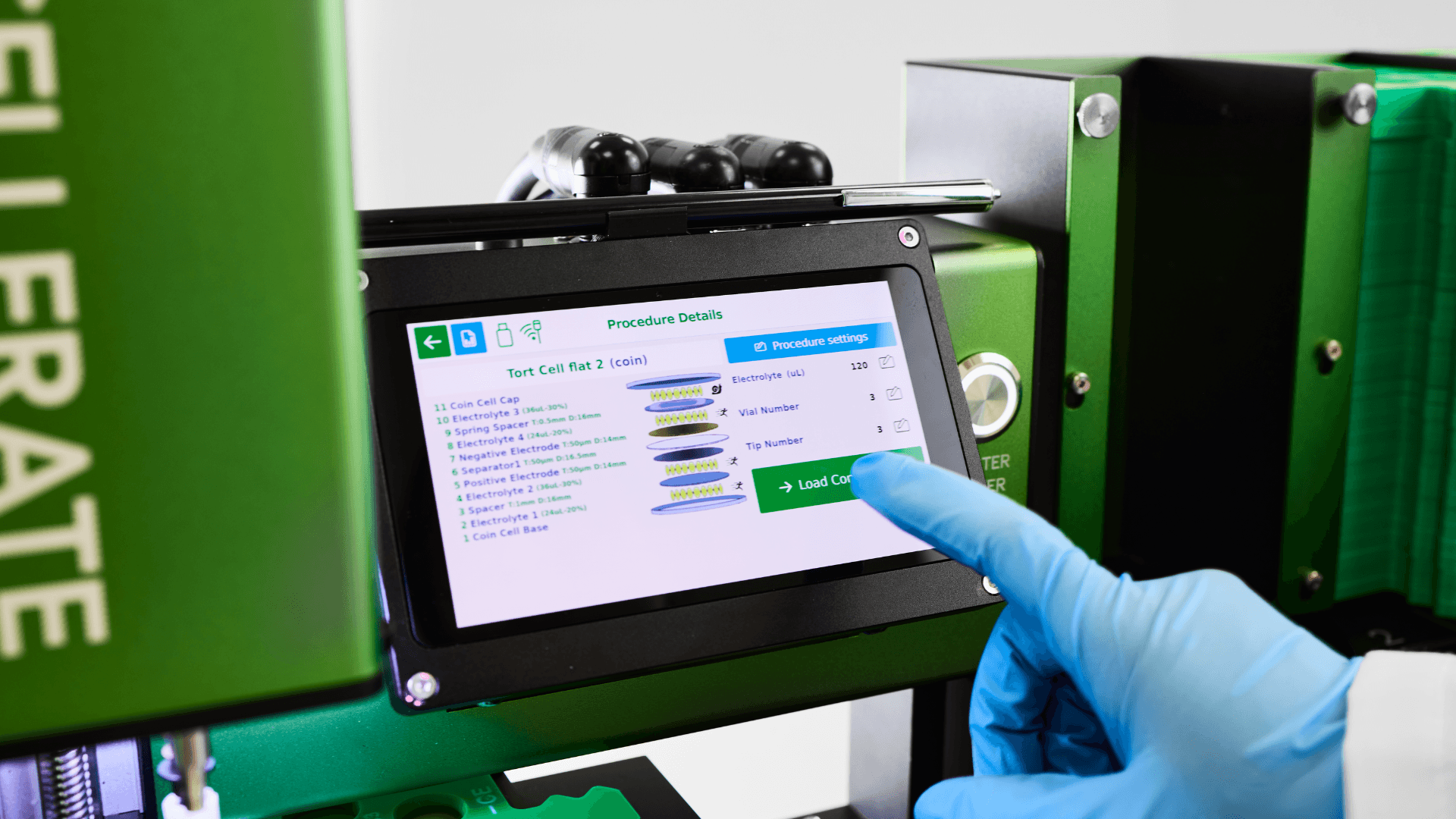
With the CASS, users can create, save, and repeat build routines, while also adapting procedures for new materials, formats, electrolytes, and assembly sequences.
That balance is central to effective battery R&D: repeatability where it matters, flexibility where discovery requires it.
Compact Battery Automation for Gloveboxes and Dry Rooms
The best automation is not always the fastest system. It is the system a lab can actually adopt, use, and build around.
Cellerate systems are designed for practical battery laboratory environments, including gloveboxes, dry rooms, and compact R&D spaces. The CASS modules are compact enough to pass through a standard large glovebox antechamber and operate in inert atmospheres, allowing labs to add automation without committing to a large bespoke line or major facility redesign.
For many teams, this is the difference between automation as a long-term aspiration and automation that can be adopted now.

Expandable Automation as Your Research Priorities Change
Battery technology is still evolving. new chemistries, new materials, and new testing requirements continue to emerge.
A modular platform gives labs room to adapt.
As research priorities change, Cellerate systems can be expanded with additional modules, upgraded tooling, new tray designs, software routines, and custom accessories. Where standard configurations do not fully meet the need, Cellerate can also support workflow-specific modifications and new process development.
This helps labs protect their investment while continuing to develop new experimental capabilities.
Built by Battery Experts and Automation Engineers
Cellerate combines battery science, laboratory experience, and automation engineering.
That combination matters. Battery labs are not generic automation environments. Materials can be reactive, delicate, variable, or difficult to handle. Workflows change as programmes develop. Equipment may need to operate inside gloveboxes or dry rooms. Data quality depends on small process details that are easy to overlook.
Cellerate’s modular approach is built around these realities.
Build the Workflow You Need
Whether you are starting with reliable cell sealing, automating assembly, expanding throughput, preparing electrodes, or exploring advanced formats such as Protocells, Cellerate can help configure the right pathway for your lab.